
Overview of Financial Sustainability
To ensure that IIUM remains a competitive centre of educational excellence, the university established IIUM Holdings (IIUMH) in 2001. The primary objective of IIUM is to help the university attain financial sustainability and reduce dependency on government funding through strategic, value-driven investments.
Our Purpose in Governance
The IIUMH Group Investment Policy is designed to assist management and the Board of Directors in effectively evaluating, recommending, and monitoring investment activities. Our governance approach focuses on:
1. Sustainable Value Creation: Ensuring the IIUMH Group Investment Policy grows responsibly while providing fair returns to shareholders.
2. Strategic Oversight: Maintaining a robust governing framework under the purview of the Board of Governors and the Ministry of Higher Education.
ESG Integration and Risk Management
We treat Environmental, Social, and Governance (ESG) factors as critical components of our Risk Analysis Framework. During the evaluation process, we identify these factors as both potential opportunities and threats to ensure comprehensive planning during project studies and ongoing operations.
Our investment risk profile considers:
1. ESG Risks: Direct assessment of environmental and social impacts.
2. Financial Integrity: Managing operational, funding, liquidity, market, and capital risks.
3. Strategic Appetite: Tailoring risk considerations based on the specific structure of the investment.
Strategic Project Investments
IIUMH invests in high-growth areas – such as new development projects, manufacturing facilities, and healthcare institutions – that align with our mission to enhance the IIUMH Group Investment Policy’s overall value. These projects are selected based on their ability to provide long-term sustainable returns rather than just short-term gains.
Operational Sustainability and Impact
As part of our commitment to good governance, every investment undergoes as impact analysis to ensure institutional stability. This includes maintaining a minimum cash balance to cover operational expenditures, ensuring that each investment remains sustainable and does not compromise the IIUMH Group Investment Policy’s daily functions.
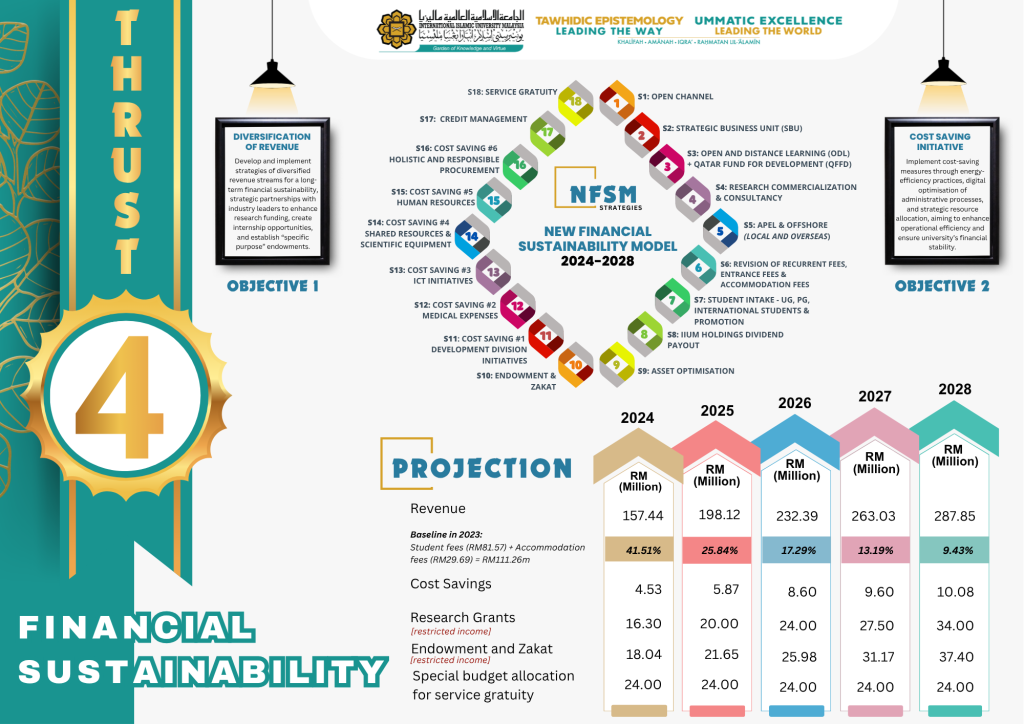
At the International Islamic University Malaysia (IIUM), our commitment to academic excellence, research, and community service is built upon a foundation of long-term financial health. To navigate the evolving economic landscape—characterized by shifting enrolment trends and the necessity for infrastructure growth—the University has proactively launched the New Financial Sustainability Model (NFSM) 2024–2028.
Our Mission
The ultimate goal of the NFSM is to bridge the gap between total revenue and expenditure, ensuring the University remains a sustainable, world-class institution that continues to nurture the “Garden of Knowledge and Virtue”.
Strategic Pillars
Approved by the Board of Governors on 28th May 2024, this strategic framework is built on a comprehensive set of initiatives designed to diversify revenue and optimize operational efficiency.
Our commitment to accountability and transparency is paramount. The NFSM is a living framework, with progress monitored through rigorous half-yearly reporting to the University Management Committee (UMC) and yearly reporting to the Board of Governors (BOG).
As of December 2024, our performance highlights include:
The NFSM is a collective, institution-wide effort involving every Kulliyyah, Centre, Division, Institute, and Office (KCDIO) across our campuses, including SASMEC @IIUM and our subsidiaries. By diversifying our revenue streams and enhancing operational cost efficiency, we are safeguarding the future of IIUM and ensuring we continue to lead the way as an internationally recognized institution that is committed to driving resilient and sustainable growth.
