
The office of Centre for Professional Development (CPD) implements relevant policies and training through its functional units. The Learning Design Unit (LDU) and Professional Development Unit (PDU) ensure all staff undergo compulsory and generic training programmes that reinforce institutional values and inclusive practices. While, the e-Learning and Micro-Credential Unit (eMCU) enhances accessibility through flexible and inclusive learning pathways.
In addition, Innovative Curriculum Unit (ICU) drives outcome-based education principles implementation particularly on the Expanded Opportunities that recognises students learn differently, offers flexible pathways, varying teaching methods, and multiple opportunities to demonstrate competencies.
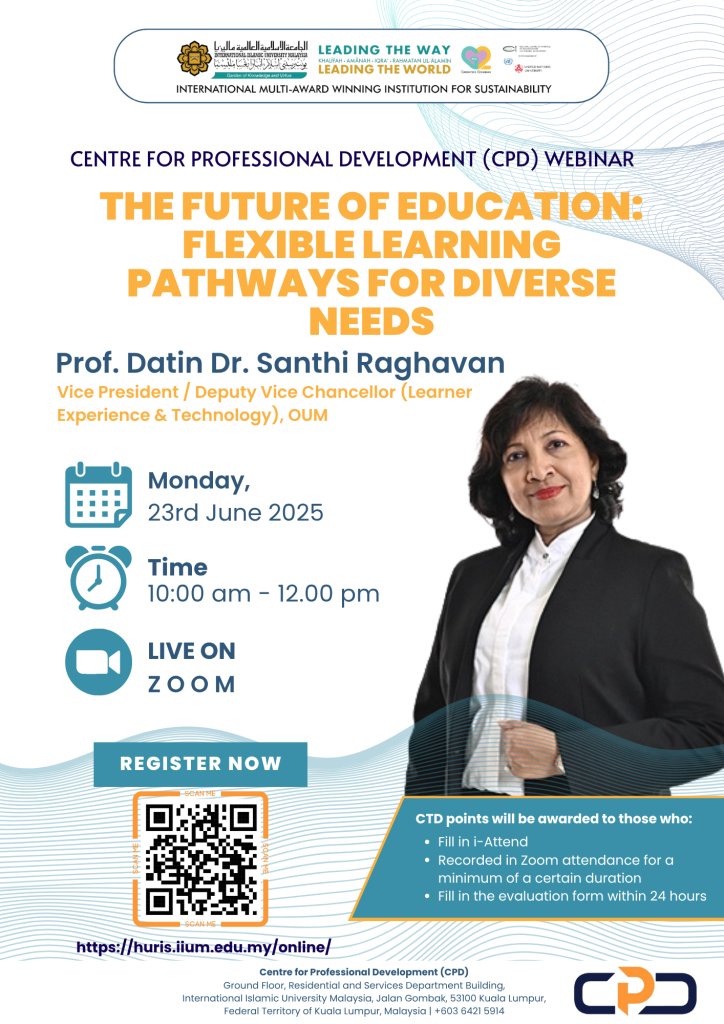
Date: 23rd June 2025
Time: 10:00 AM – 12:00 PM
Venue: Zoom Meeting
On 23rd June 2025, the CPD organized a straining titled “The Future of Education: Flexible Learning Pathways for Diverse Needs.” Hosted on the Zoom platform, the session featured an expert perspective from guest speaker YBhd. Prof. Datin Dr. Santhi Raghavan, Vice President and Deputy Vice Chancellor (Learner Experiences & Technology) at Open University Malaysia (OUM).
The IIUM Leadership Centre (ILC) plays a strategic role in leadership development at the International Islamic University Malaysia (IIUM) by advancing diversity, equality and inclusivity (DEI). Through its initiatives and advisory functions, University leaders are equipped with the competencies required to manage diverse communities (learned, learning, professional and public) and uphold holistic ethical organisational culture.
The Centre promotes leadership values rooted in fairness, mutual respect, accountability and social responsibility. These principles are aligned with the University’s philosophy of Rahmatan lil ‘Alamin, which emphasises compassion, justice and inclusiveness in institutional leadership.
A range of structured initiatives aimed at strengthening leadership capacity across the University (at multiple levels of the organisation, including senior administrators, academic leaders and emerging leaders) has been planned accordingly including the Leadership Acceleration Programme Series, Leadership Café Series, Professor–Fellow Lecture Series and leadership onboarding programmes for newly appointed academic leaders and administrators. These initiatives provide platforms for cross-disciplinary dialogue, knowledge exchange and leadership competency development, encouraging participants to engage constructively with diverse perspectives and institutional priorities.
Through leadership training, intellectual engagement platforms and capacity-building initiatives, the IIUM Leadership Centre facilitates the development of inclusive leaders who are capable of fostering equitable participation, promoting diversity and strengthening responsible stewardship in support of sustainable institutional development.
The International Islamic University Malaysia (IIUM) Code of Ethics is a comprehensive framework designed to govern the conduct of its staff and students, ensuring that all university activities align with the principles of Islam and the university’s mission of “Integration, Islamization, Internationalization, and Comprehensive Excellence” (IIICE).
The foundation of the IIUM Code of Ethics is the Tawhidic Worldview, which emphasizes that all human actions are a form of ‘ibadah (worship) and that every individual is a Khalifah (vicegerent) of Allah on Earth. This means that ethics at IIUM are not merely professional standards but spiritual obligations.
The code highlights several “Good Deeds” and values that should be embodied by every member of the university community:
Trustworthiness (Amanah): Carrying out duties with honesty and accountability.
Sincerity (Ikhlas): Performing tasks for the sake of Allah and the betterment of the community, rather than for personal gain or vanity.
Integrity: Maintaining high moral standards in research, teaching, and administration.
Excellence (Itqan): Striving for the highest quality in every endeavor, reflecting the Prophet’s (PBUH) teaching that Allah loves those who do their work with perfection.
For employees, the code serves as a guide for daily operations and decision-making:
Dedication and Diligence: Staff are expected to be committed to their roles, punctual, and proactive in contributing to the university’s goals.
Confidentiality: Maintaining the privacy of university data and sensitive information.
Conflict of Interest: Avoiding situations where personal interests could compromise professional judgment.
Brotherhood and Harmony: Promoting a positive working environment and avoiding slander (fitnah) or discrimination.
As a premier research institution, IIUM places heavy emphasis on academic honesty:
Originality: Authors must submit original work and avoid plagiarism in all forms.
Data Integrity: Fabrication, falsification, or manipulation of research data is strictly prohibited.
Authorship: Giving proper credit to all contributors and ensuring that authorship reflects significant intellectual input.
Fair Review: Reviewers and editors must act objectively and maintain the confidentiality of manuscripts under review.
Students are bound by a Student Oath that integrates academic requirements with moral discipline. Key expectations include:
Religious Obligations: Performing obligatory religious duties and observing the university’s dress code.
Moral Discipline: Prohibiting unethical relationships and maintaining a high standard of personal behavior.
Social Responsibility: Curbing ethnic polarization and promoting the spirit of brotherhood (Ukhuwah) among the diverse international student body.
The code is not merely advisory; it is a binding document. Deviations from these ethics are considered serious breaches of discipline. The university maintains a framework for:
Reporting: Confidential channels for reporting misconduct.
Investigation: Fair and transparent processes to handle allegations of unethical behavior.
Sanctions: Penalties ranging from warnings and educational sessions to formal retraction of publications or dismissal, depending on the severity of the offense.
The International Islamic University Malaysia (IIUM), utilizes a structured series of Ibadah Camp Modules to foster a holistic ethical culture among its community. These modules are designed to integrate spiritual development with contemporary social and professional responsibilities, revolving around the core concept of KHAIR (Khalifah, Amanah, Iqra’, and Rahmatan lil-’Alamin).
The “Version 2” modules (covering 2020–2026) are anchored in four primary pillars that guide the themes and learning outcomes of each camp:
Khalifah (Vicegerency): Emphasizing leadership and the responsibility of humans as stewards of the Earth
Amanah (Trust/Integrity): Focusing on honesty, self-purification, and moral excellence in work and personal life
Iqra’ (Knowledge): Promoting deep learning through Tajwid (Quranic phonetics), Tafsir (exegesis), and the study of Islamic history
Rahmatan lil-’Alamin (Mercy to all Worlds): Encouraging social outreach, environmental care, and global harmony
Annual Thematic Progression
Each year focus on a specific dimension of Islamic ethics and contemporary challenges:
Module 1 (2020): Fundamentals of Tawhid, ‘Ibadah, and Khilafah
Module 2 (2021): Developing the attributes of true believers through self-purification (Tazkiyatun Nafs)
Module 3 (2022): Strengthening Brotherhood and Unity while addressing ethics of disagreement
Module 4 (2023): Defining Leadership in Islam, with a focus on integrity within the IIUM workplace
Module 5 (2024): The obligation of Da’wah and strategies to counter contemporary issues like Islamophobia
Module 6 (2025): Reconstructing Islamic Civilization as a savior for mankind
Module 7 (2026): Addressing Contemporary Realities in Muslim societies, including global outreach and the UN SDGs
The IIUM Leadership Centre (ILC) supports the development of a holistic ethical organisational culture at the International Islamic University Malaysia through structured leadership development and values-based training initiatives.
The Centre facilitates this commitment by providing values-based leadership training / programme at multiple levels of the organisation, including senior administrators, academic leaders and emerging leaders. Through initiatives such as leadership onboarding programmes for newly appointed Deans and Directors, executive dialogues and leadership capacity-building workshops, participants are equipped with competencies related to ethical decision-making, inclusive leadership and accountable governance.
Grounded in the University’s philosophy of Rahmatan lil ‘Alamin, these initiatives foster a leadership culture that emphasises integrity, fairness, respect for diversity and responsible stewardship within the University community.
The office of Centre for Professional Development (CPD) plays a central enabling role in facilitating a holistic ethical organisational culture by providing continuous professional development integrated with Islamic values, ethics, and professionalism to uphold integrity; promoting reflective teaching for holistic competency development; supporting ethical leadership grounded in tawhidic epistemology; and enhancing curricula by embedding values-based elements into learning outcomes and student experiences.
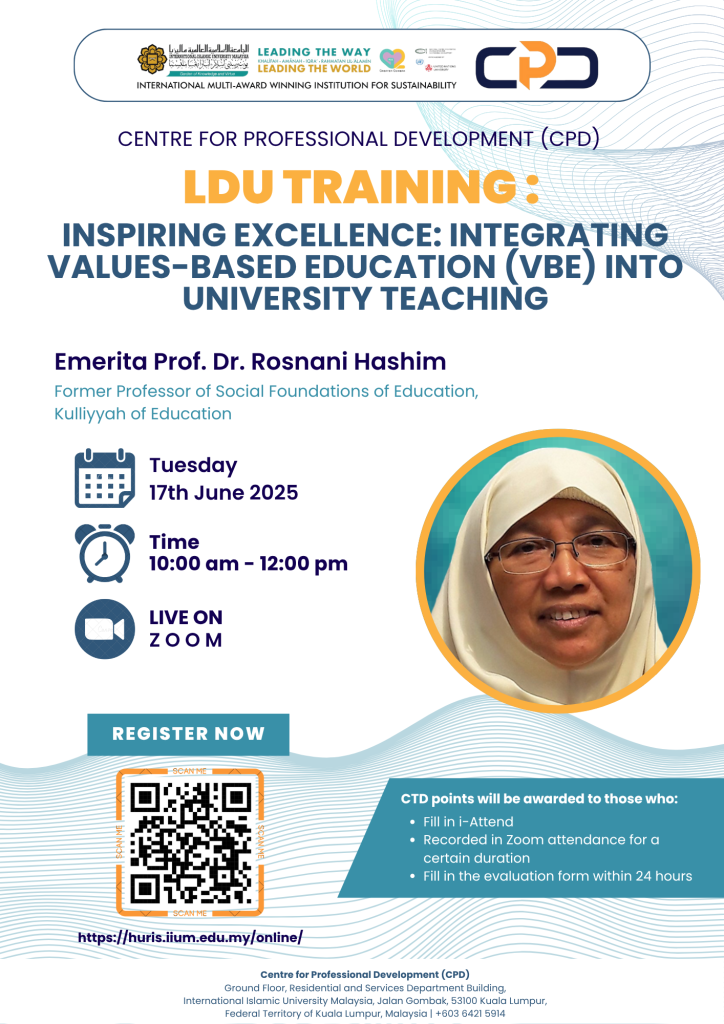
Date: 17th June 2025
Time: 10:00 AM – 12:00 PM
Venue: Zoom Meeting
On 17th June 2025, the CPD hosted a compelling training titled “Inspiring Excellence: Integrating Values-Based Education (VBE) into University Teaching.” Conducted via the Zoom platform, the program featured Emerita Prof. Dr. Rosnani Hashim, a distinguished former Professor of Social Foundations of Education at the Kulliyyah of Education, as the guest speaker.
