
NURTURING UMMATIC EXCELLENCE THROUGH SDG 12 : RESPONSIBLE CONSUMPTION & PRODUCTION
Unsustainable patterns of consumption and production lie at the very heart of today’s triple planetary crisis; the intertwined challenges of climate change, the loss of biodiversity and ecosystems, and the mounting tide of pollution and waste. Aware of the urgent need for transformative action, the International Islamic University Malaysia (IIUM) has embraced its responsibility as a catalyst for change. IIUM is committed to translating its sustainability vision into practical action across all areas of university life. This commitment is reflected in ethical procurement, responsible waste management and continuous efforts to reduce the environmental footprint of campus operations. Through policy implementation, monitoring and innovation, the University demonstrates that institutional integrity and sustainability are deeply intertwined ensuring that every decision contributes to the well-being of people and the planet.
OPERATIONAL MEASURES
Through the IIUM Sustainability Policy, the University reimagines its role in serving humanity and the planet by embedding sustainability within its three functions: teaching, research, and community engagement which aims in nurturing a generation inspired to live, learn, and lead sustainably.
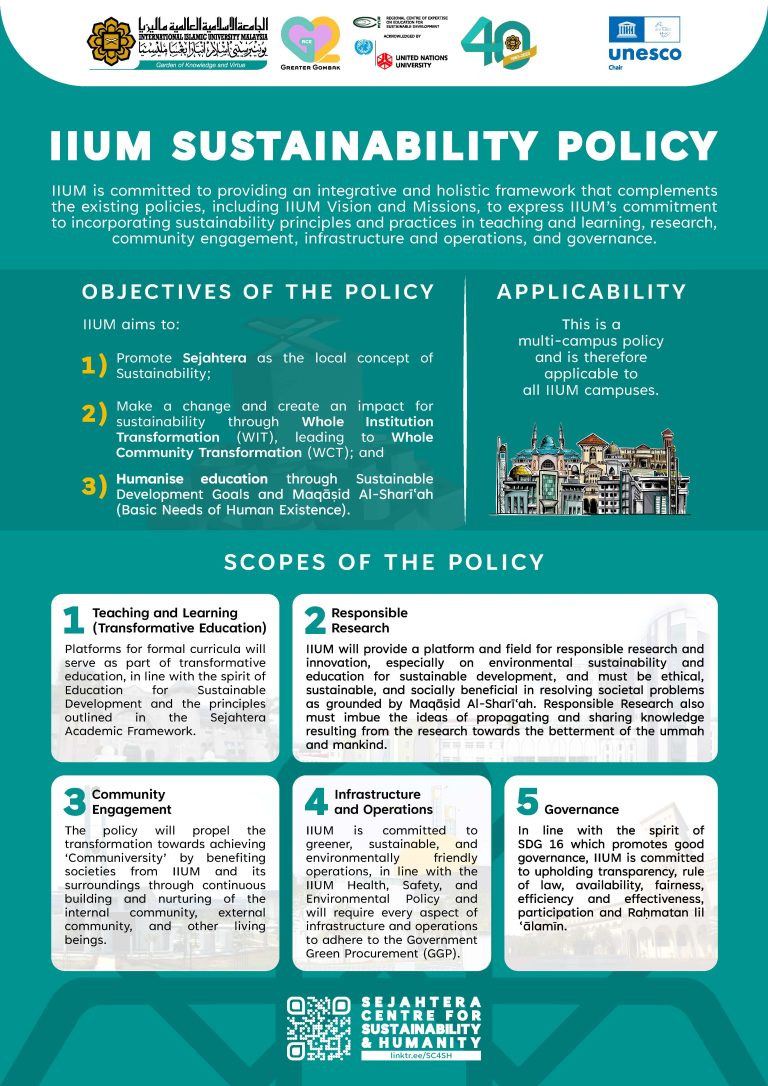
Within and alongside the IIUM Sustainability Policy, the University is committed to translating its sustainability vision into tangible and measurable actions. To ensure this, IIUM continuously strengthens its operational measures, focusing particularly on ethical sourcing practices and responsible waste management; especially in handling hazardous materials as part of its broader effort to uphold environmental integrity and social responsibility.
Ethical sourcing policy
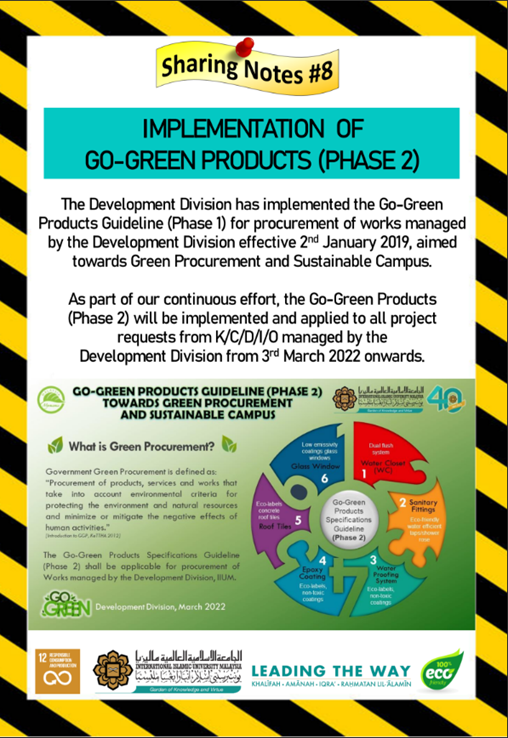
In line with the commitment towards Responsible Consumption and Production, the IIUM Development Division has taken proactive steps to turn policy into practice through the Go-Green Products initiative, implemented in two phases; Phase 1 in 2019 and Phase 2 in 2022. This initiative redefines the University’s procurement processes, embedding the principles of Green Procurement and Sustainable Development to ensure that every project and material used on campus reflects IIUM’s dedication to a greener and more sustainable future.
Policy waste disposal – hazardous materials
Recognizing that the safe disposal of unused and expired medications is vital to protecting both public health and the environment, the Sultan Ahmad Shah Medical Centre @ IIUM (SASMEC @ IIUM) has taken a proactive step towards responsible healthcare stewardship. Guided by this awareness, SASMEC @ IIUM developed the Guideline for the Management of Near-Expiry and Disposal of Medical Items; a comprehensive framework designed to assist personnel in safely handling expired, unused, returned, and tampered medical items. This initiative reflects the IIUM’s deep commitment to upholding the highest standards of safety, sustainability, and ethical medical practice, in alignment with national regulatory policies and the University’s broader sustainability vision.
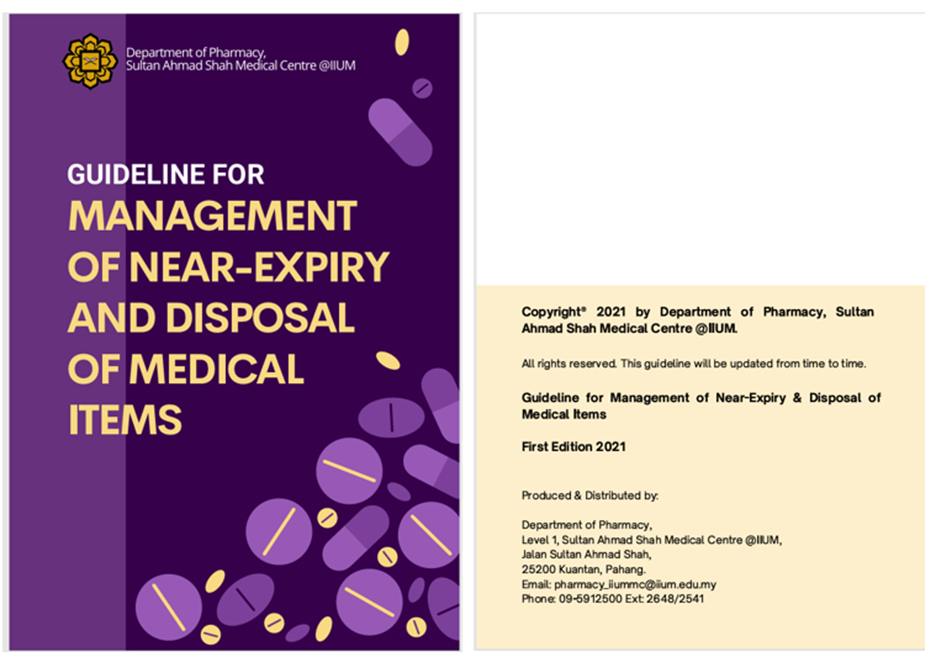
Guideline for Management of Near-Expiry and Disposal of Medical Items
Waste & Minimisation Initiatives
In line with the national blueprint and the IIUM Sustainability Policy, waste minimisation efforts combine education, research and community participation. The initiative includes:
- Recycling and food-waste separation facilities, supported by IIUM Daya Bersih Sdn. Bhd.
- The development of an IIUM Code of Practice for Waste Minimisation.
- The Zero Single-Use Plastic Campaign to raise awareness and reduce dependency on disposable items.
- Course integration and research on waste management and composting, providing students with real-world learning opportunities.
- Use of compost for edible gardens and landscaping to reduce fertiliser use and enhance soil health.
PROPORTION OF RECYCLED WASTE
The Environmental Performance Monitoring Committee (EPMC) plays a central role in tracking and managing waste across the University. Its initiatives, such as Recycle Day 3.0 which collected 53 tonnes of used textiles, demonstrate measurable progress. Through systematic monitoring and reporting, the EPMC establishes baselines and targets for waste reduction and recycling, ensuring transparency and continuous improvement.
https://office.iium.edu.my/ocd/epmc/
PUBLICATION OF SUSTAINABILITY REPORT
The IIUM Sustainability Report provides transparent, annual updates on targets, metrics and case studies, including SDG 12 performance, waste diversion rates and procurement milestones. It supports benchmarking, governance and continuous improvement.
